Showing posts with label Yates. Show all posts

Thursday, January 19, 2017

Mennonite Stores


A while ago I mentioned in a post about an old cookbook and cooking the way they did in the 50’s. But where do you find the ingredients? Grocery stores are now supermarkets. They have all kinds of exotic foods and many meals ready to just heat and eat. It’s wonderful for the person pressed for time or who doesn’t know how or want to cook. However, when you’re looking for basic ingredients, especially those that aren’t very popular anymore, where do you look? The supermarket might have them tucked away in some corner, then again maybe they don’t.

As you’re driving around the Finger Lakes area you might stumble upon a store that has just what you want. 


In areas with Mennonite settlements you’re likely to come across a little store run by one of these families that has many such basics on their shelves. Oh, they have many modern convenience foods and junk food as well, but their specialties are basic foods to feed their families. Many of these stores will be housed in small sheds near the house on an operating farm. Tiny and compact, the farm wife will run out from the house where she was working on something to help you when you stop at her store.  Many have food products, and others might have what used to be referred to as “dry goods.” Small items for the household, especially sewing  notions and material are for sale. Others are a combination of the two. You never know what they might hold until you stop in and have a look.

Probably the biggest—at least around the Finger Lakes area—is Sauder’s Market. It is located between Seneca Falls and Waterloo on the River Road. In fact, at first sight, you wouldn’t think it even was a Mennonite grocery. They have expanded until they are as big as a small supermarket with a parking lot to match.

Walking inside it seems un-Mennonite and more typical of an American supermarket with bright lights, wide spaces and even a small café along the side. However, a second glance will show that it is indeed Mennonite owned and run. The female staff is dressed in traditional dresses with caps on their heads. Many of the customers are similarly dressed as well. The male staff, of course, isn’t as obvious since their traditional dress more closely resembles modern dress for men.

Walking along the aisles you will find fresh produce, jams and preserves along with basic baking supplies and other grocery staples. The bakery has old-fashioned homemade bread, rolls, cinnamon buns and whoopee pies even. If you get there early enough, you’ll have a large choice of pies as well. In one aisle you will find supplies for canning along with apple corers, pastry sifters and other kitchen implements not often found in the modern kitchen equipped just for quick meals.

Here is where you readily find these old style basic ingredients. But what if you don’t have the recipes to use them? Over in the corner of the store is a book section. There are many inspirational and children’s books as well as ones on the Mennonite and Amish religions. But don’t overlook the aisle that is full of cookbooks. Books by Amish and Mennonite communities as well as ones about preserving food are available. All kinds of delicious goodies can be found within these cookbooks!

So, for a trip back in time or just to another culture, don’t overlook the little stores here and there among the rural areas of the Finger Lakes. Especially, don’t miss stopping by the bigger ones such as Sauder’s if you are near them. You are in for a real treat!

Tuesday, August 16, 2016

Mennonite Deaths


Their church
Last weekend I wondered about some of the details of the Mennonite religion. While on a trip to nearby Yates County in the Finger Lakes region, we stopped at a cemetery that belongs to a group of Mennonites. Situated along side their church, the cemetery is small compared to most others in the area. The Mennonites started moving to this area somewhere in the 1970’s, but it has only been in recent years that any large number have located in the area.

Looking at the stones in this cemetery, I wondered about the experience of pregnancy and birth for the women of the community. Do they have more problems with giving birth and losing children than what people in the general population, those of us they call “the English” do? It may seem strange to be thinking about the beginning of life while standing in a place representative of the end of this journey. However, there was a distinct reason that these questions came to mind. Probably somewhere between 70 and 80 percent of these graves were for children and infants.

While it is understandable that there would be few older people buried yet in a cemetery that was created by a community fairly new to the area, it was surprising to find so many young people. Many of the stones gave birth and death dates that were only a few days apart. One listed how many hours and minutes the baby lived. Others only had one date and the word “stillborn” inscribed on them. It was heartbreaking to see so many, especially the neat little row of five stones-- all from the same parents. Why I wondered. Did they have a problem that we don’t? Is there something genetic that is happening to them? Do they shun modern health care that would have prevented some of these early deaths?

Many sites that I looked at on the Internet concurred with what this one has to say: www.ncbi.nlm.nih.gov/.../8296784
It seems that while the group as a whole have a few more genetic disorders surfacing due to the fact that they don’t marry across a wide population, their healthy life-style balances this out. Therefore, the rate of infant mortality is not much different than that of the general population.

The Mennonites, while shunning many of our modern technologies, don’t object to ones that they find helpful. For example, some groups do not own cars due to the temptations of more modern life that they lead to. However, they don’t object to members riding in someone else’s car when they need to get somewhere quickly or at a great distance. This balance between temptations and what is helpful would certainly allow for medical intervention by the English if there was a problem during pregnancy or childbirth.

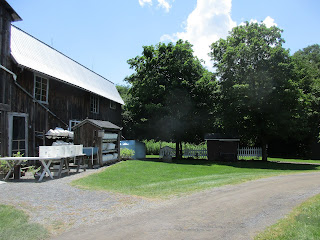
Shelter for the horses during services
The only conclusions I could come to is that either it is a sad coincidence that there are so many deaths at a young age, or that they are perhaps more willing to acknowledge such loss and create memorials to the children than we in modern society are likely to. It is a common fact that they tend to have larger families than others do and so perhaps, too, it is just a law of averages at work and being a newer community, it is more noticeable in the graveyard. Whatever the reason, I found it sad and touching how many small children were remembered in their short lives. This is a part of why we do genealogy, to remember those that have gone on before us. I think especially, those that were here for such a short time that they didn’t live much of a life or have many people get to know them are important for us to acknowledge and remember.

Thursday, January 14, 2016

Yates County


Yates County Genealogical Society and History Center
107 Chapel St, Penn Yan, NY 14527
www.yatespast.org/

The first time I visited Penn Yan that I can remember is also the first time that I visited the History Center. It seems strange, having grown up in the midst of the Finger Lakes that I had never been there before, but I could not recall being there before that spring day when my husband and I drove down to a New York State Council of Genealogy Organizations (NYSCOGO) meeting. Rich had not been there before either, but by the time we had driven down between the lakes and were pulling into the village, he was exclaiming not only how beautiful it is, but his desire to retire to the area.

The Finger Lakes region really is that beautiful. The area surrounding Penn Yan is even more picturesque then some of the other areas because of a group that ha settled there during the last thirty or forty years. Families of Mennonites, a religious group known for their plainness and adherence to older ways, have bought many farms in this area. They are restoring these farms and maintaining them in such a way that you could almost imagine yourself back in the 1800s. Adding to the illusion is the fact that they don’t drive automobiles, but rather, rely on horse and buggy for most of their transportation.

This is actually from Lancaster, Pennsylvania but typical of what you might see in Yates

The History Center consists of different parts. Besides the research rooms, there is also a carriage museum and a Victorian home. The research center has extensive cemetery records for Yates county as well as deeds (1792 - 1949), mortgages (1862 - 1915), diaries, almanacs, certificates, personal correspondence, etc., newspapers on microfilm and other items pertaining to Yates County history.

Hours: Tuesday – Friday, 9:00 a.m. to 4:00 p.m.

Non-members are charged a $5.00 per hour fee for use of the Catharine Spencer Research Center; Student use is without a fee; photocopying is additional.

Because I was there for the meeting, I did not have time to properly explore this repository. Although I don’t have any personal research in the area, I look forward to getting back there and doing a thorough job of seeing what is in all of these records. Also, the next time I get there, I need to remember my camera to capture the unique beauty of the area.