Central New York Research. The eclectic ramblings of doing genealogy and growing up in that part of Upstate New York that is the central and Finger Lakes regions. With ancestors all over the northeast and beyond, there will be forays outside the area with trips and news on family history as well as local history.
Who has heard about Conference Keeper? For those who haven’t, it is time you got over to this website: https://conferencekeeper.org It is the place to be! Having said that, I admit that I go there about once a week. Sometime after I get an email from them, I click on the conference link. I find it easier to go directly to the site, rather than reading the updates in the email. However, for some, they go to the site, subscribe to the weekly email then just read that rather than going back.
They state that it is their mission is to help individuals to increase their knowledge, skills, and enjoyment of genealogy. According to their own claims, and I’d easily believe it, they are the most complete calendar of genealogy events- anywhere.
Subscribe? Do I have to subscribe to something? Do I need to pay for this? No and no. It is a free website and the subscription is also free and optional. I find it helps as a reminder in my busy weeks that the site exists.
So, what is this site all about? It’s in the name. They “keep conferences.” That is they keep track of conferences going on in the genealogy world. There is a listing of conferences from all over that are coming up. Many of them are US-based, but there are ones in different countries around the world as well.
Each listing will tell you if the conference is virtual or in-person or both. Also, if there is a fee, a $ sign will appear. There is a title of the conference and a brief blurb telling you a little about that particular conference. Click on the title of the conference and you will be taken to a web page by the organization with even more information and a chance to register for that event (if you need to, of course).
There are links to look at conferences in different ways. You can see just Virtual conferences, for example, or by area.
There is so much more available as well!
Are you a speaker looking for new conferences? They have a call for papers section as well. For those unfamiliar with this phrase, many conferences send out a call for papers when they are planning a conference. Potential speakers then submit their proposal for a talk and a committee selects the ones they feel are the best fit and contribute good variety for their conference. Often the proposal is an outline of the talk with a blurb about it and sometimes as far as the handouts that participants see in the syllabus. Although almost always the syllabus pages are done long after the speaker has been accepted and closer to the time of the event.
Looking for educational opportunities? There is a page where I counted 18 different institutes and other long-term educational opportunities. These are the ones that go more in-depth than a speaker at a conference can do. Of course, they cost money. Want to take advantage of these programs, but can’t afford to? There’s also a page of grants and scholarships that might be able to help you out. Both years that I attended IGHR, I had a scholarship that helped me with the expenses. I forget how much the first one was, the second covered my tuition and allowed me to register ahead of time, thus securing the class I wanted. Classes at institutes fill up fast and it is sometimes hard to get into the one you really want to take.
There are Volunteer opportunities if you have some extra time on your hands. Also, podcasts that you can listen to whenever you have a few minutes. Good at genealogy but need a job? Conference Keeper even has a page of job opportunities in genealogy available.
Yearn to travel with genealogy? There’s a category of Travel, Tours, and Cruises. Although I think I’d hold off on that aspect until COVID is over, it never hurts to dream!
As you can see, there is much to Conference Keeper and a website that you really need to check out. I just skimmed over the various offerings and I’m sure I missed something. In fact, before writing this column, I didn’t realize some of the pages that are available myself!
With COVID creating problems throughout the country and world many organizations have not been having meetings, conferences, or institutes. Others have been holding them in the visual realm. They have scrambled to re-organize and are using Zoom, Go To Meeting, and other virtual means to hold their meetings. Many conferences have gone virtual in the past year. Almost all institutes where you go for a week-long course in a particular subject have been held virtually since COVID broke out. Many people in the genealogy world are saying this is the wave of the future. But is it? And Should it be?
I am hoping it is not. I don’t want to stop going to in-person events. There is a feeling I get when attending these various events. I can almost feel the energy flowing into me, especially at conferences and institutes. It re-energizes me and gets me wanting to do even more genealogy. I don’t feel that energy when I attend a virtual event. In fact, I feel almost as though I”m hiding in a closet with my computer and a flashlight. It is like a futuristic book I once read of a world where people were living in storage units and afraid to come out and interact with others.
True, there are a lot of advantages to virtual environments. It is safer from an illness vantage point. It is easier to get to, with less travel and expense; you can squeeze it in easier around other commitments, and it has fewer hurdles for people with handicaps or older people that just don’t get around as well anymore. On the other hand, you lose the easy ability to mingle and talk with like-minded people and you don’t get a chance to explore a new area. The last two are some of my favorite parts of conferences.
From the point of view of people putting these together, virtual creates the hurdle of learning new technology as well as potential problems with pulling it off. Power outages and low wi/fi signals are a couple serious problems that quickly come to mind. Other people in the household interrupting or doing silly things in the background of users' screens are others. I’m sure there are a number of other behind-the-scenes stuff that I don’t immediately see. To the positive, I’m sure a totally virtual conference could be pulled off with fewer volunteer hours and eliminating the need to rent a large space with plenty of hotel rooms nearby to hold it. Perhaps it could even prove to be more profitable doing it virtually?
What is the answer? What should the genealogy community do going forward? Nobody really knows at this point, although many have ideas. Which one or would a combination be the solution? We all will have to wait to find out.
Overall, I think there are pluses and minuses to both of them. Different people have different preferences, and it also depends on circumstances in their lives. In an ideal situation, we could have hybrid conferences and institutes going forward. Those who wish and can attend in person get to do just that. Others can tune in via Zoom or whatever technology is used and participate that way. While I’ll always prefer to attend in person, I’m sure there will be many times when I and others will be grateful for the virtual options as well. Let’s shoot for as many conferences and institutes as possible being hybrid going forward! It will take more work, at least initially, on the ones creating these events. However, I think after the experiences of the past year, that even the extra work will be worth it. Also, soon people would become so used to this way of putting on an event, that it would become second nature.
On Saturday, we took a quick trip along the North River, aka The Hudson River from earliest settlement to 1800. This was the theme of both the first presentation and the all day conference at Central New York Genealogical Society. Jane Wilcox, an expert on the Hudson River area of New York State, gave four separate presentations.
Many people think of the earliest settlers to this area as the Dutch who settled New Netherlands with Fort Orange. They would be wrong. Actually, the Walloons, a group from Belgium came here before the Dutch, who had claimed the territory, arrived. They were the very first settlers after the Native Americans and blazed the way for the other settlers.
We learned, also that there were a few more groups of various ethnicity and religions that settled this area during the time period. Jane asked for guesses in the beginning of the lecture. The answers ranged from single digits up to about 20. Having heard the lecture before, I jokingly put out an answer of 100. I knew mine was too high, but knew there was many more than most in the audience imagined. The actual answer was somewhere around 45, depending on if she had actually found all or not.
A Tale of Woe is an interesting case study that Jane presented next. Starting from the mention of an unmarried relative in a printed genealogy, she brought to life one of her collateral ancestors. Probate and court records, among other sources were able to reconstruct the life of this woman who fought the conventions of the day. She disagreed with her brothers on matters and brought a child into the world just before she died, still unmarried. The case study describes what happened to this child as well. In an interesting twist, we found that the president of Central New York Genealogical Society, Chris Wilcox, is also a relative of this woman on a different line of descent.
The afternoon started with a lecture on the tenant farms of the Hudson Valley. We learned about the patents and manors. These consisted of vast holdings by the wealthy of thousands of acres in this area. For decades these lands were rented. Thus, the people that settled here were unable to own the land themselves. Even without deeds to the land, there are various ways to trace these settlers as Jane showed us in this lecture. Many of the leases are for three lives. What surprised many is that this is not three generations, but for the lives of three people mentioned within the lease. It could be a husband, wife and child or three brothers or any combination of people that had an interest in the land. Once the last of them died, the lease would revert back to the landowner.
Finally, we had a whirlwind tour across Upstate New York. We learned about various libraries, archives, historians, historical societies, genealogy groups and online sources for information on our ancestors. Using a small sample from each category, Jane demonstrated what a rich variety of resources are available and how to make use of each of them.
Here is an upcoming CNYGS all day event with Jane Wilcox! Mark your calendars. I've heard most of these talks at regional conferences and they are good. If you haven't heard them already you don't want to miss this event. If you've already heard them, you probably would enjoy hearing them again!
This Genealogy Fair isn't coming up until September, but mark your calendars. I was able to get to it last year and it is a nice event. Although small, it concentrates on just one county, so there is a lot of good information available there. The people staffing the booths are very knowledgeable about their areas. Oh- and did I mention there's a barbecue lunch available for purchase? Feed your brain and your stomach!
Well, I am exhausted. My head is in a whirl. I’ve written a
“To Do” list that is one notebook page long for just genealogy projects. And I
am anxious to work my way down all of this! What produces all this you might ask?
A genealogy conference!
A scene from the exhibit hall
We returned home Sunday evening tired, but happy from the
New England Regional Genealogical Conference (NERGC) in Springfield,
Massachusetts. This was a three-day conference with a side trip to Old
Sturbridge Village thrown in. For a genealogist, it is like a child being let
loose in a candy shop!
The conference, rather obviously, concentrated on New
England research and resources, particularly those in western Massachusetts
where it was held. However, there are a lot of classes on various topics and
they don’t all restrict themselves to this area. There were classes as well on
general research methods, Irish research, writing, DNA and military amongst others.
One presenter, Jennifer Zinck, had agreed to do a workshop
on DNA. Shortly after registration opened, she agreed to do a second, as the
first one had sold out almost immediately. I attended many classes that talked
about writing your family history and others that dealt with various areas of
the region. One in particular that I enjoyed by Dave Robison talked about the
repositories of western Massachusetts. Although I have no ancestors in those
places, mine lived across the border in New York State and created at least a
few records across that artificial line. There were New York State resources as
well. I didn’t get to attend, but I understand that Jane Wilcox did a wonderful
whirlwind tour of the various repositories available throughout New York State
giving specific examples of each.
One that created many items on that “To-Do” list of mine was
a talk by Michael Strauss on World War I records. I’m not that interested in
military, so hadn’t thought much before about the various records that might be
available for my grandparents who served in this war. His talk definitely kept
my interest and gave me several places to look for records. Luckily, I had a notebook with me to scribble
down all those ideas as they occurred!
This is just a small sampling of the courses that are
available in different sessions. One of the best parts for me is the
networking. I get to see people that I know only through the virtual world of
email lists and Facebook. We get to actually talk with each other and share
what we are working on. We get to laugh and joke and hang out with each other.
To attend this conference again, we have to wait two years. It
is a bi-annual conference and the location rotates around New England with a
few restrictions on locations. The planning committees need to choose a place
that has a large enough conference center and enough hotel rooms available
nearby to accommodate it. I understand that they can no longer go to Vermont,
as there is no place large enough for it. On the flip side it is not quite big
enough for some of the bigger conference centers. Therefore, it seems to rotate
between cities in Massachusetts, Rhode Island and New Hampshire at the moment.
So where to next? Well pull out your calendars and mark
April 3-6, 2019 down. If you don’t have the route plotted out already, pull out
the maps and find Manchester, New Hampshire. It’s just a short drive outside of
Boston, and if you don’t want to drive in Boston (I certainly don’t), you just
take some of the interstate highways around the far, far edge of it. We have
our calendars marked already and I hope I’ll see you there! Now I got to get
back to work—where are those forms to request records...
And another conference is getting ready for registration. Visit:
http://www.gen-fed.org/registration-details-for-gen-fed-2017-released/
...or see the announcement below. Gen-Fed, if you haven't heard of it is a week long festival of federal records. Held in Washington, D.C., you will be immersed in presentations about various federal records and be right there to dive into them! I understand there are field trips to not only the repositories in D.C., but also NARA in Maryland during the week.
National Archives Archives, Constitution Avenue
The Genealogical Institute on Federal Records (Gen-Fed) has announced
details on registration, scheduled to open on Saturday, February 25, at
3:00 PM EST. Reservations will be taken online, via 123SignUp, and
tuition payment will be due by check within 15 days of making a
reservation. Complete instructions are posted here. Read them over and mark your calendars!
If you are wondering if Gen-Fed is a good choice for you, check out last year’s post entitled “Are You Ready for Gen-Fed?” For other perspectives on how this institute fits in a genealogical education plan, read blog posts by Dave McDonald and DearMyrtle.
To learn more about this year’s program, visit Gen-Fed-2017.
And yet another news release arrived in my inbox. The early registration ends this month, so if you're planning on going and haven't registered yet- why not? The little countdown on my computer says 2 months and 17 days until we leave for the conference!
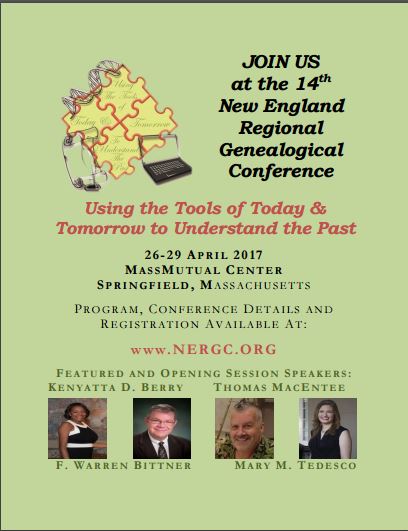
“Using the Tools of Today & Tomorrow
to Understand the Past,” the 14th biennial NERGC Conference, will bring
together 75 leading genealogy speakers and over 900 genealogists from
around New England and the US at the MassMutual Conference Center in
Springfield, Massachusetts.
Additionally, approximately 70 vendors of genealogy related products, services, software and books will be in the Exhibit Hall.
The program includes not only the individual presentations but
workshops covering DNA, Italian research, paleography, Portuguese
genealogy, photo identification, and more. Featured speakers are Thomas MacEntee, F. Warren Bittner and Kenyatta Berry, a co-host of the PBS series, Genealogy Road Show. The remaining schedule of speakers will cover genealogy at all levels, from beginner to expert. NERGC
is a regional, volunteer organization supported by 23 genealogy
societies, all of which will be represented by their members. The program begins on Wednesday, 26 April 2017
with a schedule of specialties in 5 main areas: Librarians, DNA,
Society Management, Professional Genealogy, and Technology as well as
four stand-alone workshops on Getting Started, Family History Books,
Military Records, and Deeds. The main conference begins on Thursday, 27 April with a presentation by Mary Tedesco, another co-host of the PBS series, Genealogy Road Show, and continues through Saturday, 29 April 2017. During
the conference, registrants can choose to spend time with a
professional genealogist at the Ancestor Road show, walk through the
Society Fair, participate in a Special Interest Group discussion, or
enjoy the sites of and resources of Springfield, MA. Early bird registration ends on 28 February 2017. Visit www.nergc.org
to register, select the programs you’d like to attend, and, optionally,
the lunches and dinners, most of which are sponsored. Luncheon speakers
are Thomas MacEntee, NEAPG Table Topics, and Jane Wilcox while the
banquets include presentations by Kenyatta Berry on Friday and Thomas MacEntee on Saturday.
RootsTech is busy lining up speakers for their annual conference and have announced another of their Keynote speakers. Buddy Valastro, aka The Cake Boss will be the Keynote speaker on Saturday February 11th. My question is will he be handing out free samples?! That would certainly be a yummy presentation!
Here is the official press release:
The Cake Boss Buddy Valastro Will Keynote, Judge at RootsTech 2017
SALT LAKE CITY, UT, 27 October 2016)--RootsTech,
the largest family history conference in the world, is pleased to
welcome the popular Italian-American celebrity chef, Buddy Valastro,
also known as the hit TLC series, Cake Boss™ as a keynote speaker on Saturday, February 11, 2017, in Salt Lake City. Valastro will also judge a local cake decorating contest hosted by RootsTech.
The
amicable Valastro is a Hoboken, New Jersey, resident and owner of
Carlo’s Bakery. He has endeared himself to millions of people as the
animated, passionate chef on the TLC series, The Cake Boss. His
staff’s creative expertise in designing over-the-top cakes for locals
and celebrities is only half the allure. The show’s long-running success
can also be attributed to the fun, dynamic interactions and involvement
of 3–4 generations of Valastro’s Italian-American family who help run
the thriving family business.
“Family is the most important part of my life,” says Valastro. “You
have to embrace and be proud of where you come from. I can't wait to
share my story of how my past, present, and future have shaped who I am
with the audience.”
During his RootsTech 2017 keynote address, the Cake Boss will share
the story of how his strong family ties, roots, and traditions have
shaped his life and business success, which include 12 bakeries,
additional TLC series (The Next Great Baker and Buddy’s Bakery Rescue), and several books, to name a few.
Running bakeries is almost genetic in Buddy’s family. His grandfather
and great-grandfather were both bakers in Sicily, Italy. His father,
Buddy Valastro Sr., ran his own bakery for many years in New Jersey.
When Buddy Valastro Jr. was 11 years old, he began working side by side
with his father at Carlo’s Bakery.
Buddy Sr. died when his son was 17, leaving a very large hole in the
teenager’s life. However, his tutelage had provided Buddy with
“cast-iron business sense” and imbued in him a work ethic and a wealth
of knowledge. He stepped up and took over his father’s role as
proprietor and baker in Carlo’s bakery.
Buddy learned much without his father’s presence in the business but struggled making sfogliatelle dough,
which is used in making Italian shell-shaped filled pastries called
lobster tails, one of the bakery’s specialties. Buddy recalls the night
his father came to him in a dream and told him, “I am here for one
reason, to show you how to make lobster tails.” The next day, for the
first time, Buddy successfully created the seemingly impossible dough
and the very popular lobster tails were back. From then on, he says, he
knew he could do anything he put his mind to and found comfort knowing
that his father was looking after him.
After a few years, Buddy Jr. decided to take cake decorating to a new
level with designer cakes. He created, among other spectacular cakes, a
NASCAR racecar cake weighing over 10,000 pounds. In 2004, he was
invited to participate in the Food Network Challenge where he took top
prize in the fourth battle. He was urged to try a show for himself so he
pitched a show featuring himself with his family. TLC executives were
impressed enough to shoot a pilot episode in the shop which was a hit
with audiences, and Cake Boss was born. The show is now in its eighth season.
Buddy’s extended family is indispensable both to the show and in
running what has now become a chain of bakeries in New Jersey, New York,
Philadelphia, Las Vegas, and some Norwegian Cruise Line ships. The
business has diversified and expanded, but the legacy that began three
generations ago in Sicily lives on. Buddy willingly holds to the
traditions of his father’s bakery.
“Life lessons my parents have taught me define who I am today. I
never forget where I've come from and try to pass that down to my
children today,” says Valastro.
In addition to keynoting at RootsTech 2017, Valastro will help judge the first-ever RootsTech cake decorating competition.
There will be four different categories to compete in—wedding,
birthday, holiday, and graduation—and there will be three finalists and
one grand prize winner selected in each category. Cakes will be on
display Saturday
during RootsTech and Family Discovery Day where thousands of people
will view and have a chance to vote for “People’s Choice” winners in
each category. Official rules and entry information for the contest will
be available soon at RootsTech.org.
FamilySearch and RootsTech sent out this announcement this morning. RootsTech is the largest genealogy conference in the United States-- I don't know, but maybe even in the world. It started out as purely a conference for programmers and other such technology deep people to meet with genealogists to know what they were looking for in software programs, databases and the like. It has since grown to be an all encompassing genealogy conference. While it is too big and crowded for an introvert who can't stand crowds like myself, it is a great conference for those that thrive on such large groups. Also, there are usually a few sessions shown either live or at a later date on the Internet. A great combination to include everyone- even those who would want to attend, but can't afford to!
Reading Rainbow’s LeVar Burton Will Keynote RootsTech 2017
Salt Lake City, Utah, USA (October 19, 2016)—FamilySearch International is pleased to announce that LaVar Burton will be the Friday keynote speaker at RootsTech 2017 on February 10, 2017.
Burton is known by millions for his legendary starring role as Kunta
Kinte in 1977 in the globally acclaimed and award-winning ABC mini
series, Roots, as chief engineer Geordi La Forge in the iconic Star Trek: The Next Generation television series, and as host and executive producer of the beloved PBS children’s series, Reading Rainbow. Burton was also the co-executive producer of the re-envisioned production of Roots that aired in June of this year on the A&E Networks. Reading Rainbow
was one of the longest running children’s television shows in TV
history (1983-2009) and one of the most acclaimed, earning more than 200
awards including 26 Emmys and a Peabody. "There's a whole new
generation of kids that need to develop a relationship with the written
word, especially, I believe, in this ultra-technological age. I'm in
this for the mission. This is what I do," said Burton.
He is excited about the opportunity to keynote at RootsTech where he plans to share personal stories about Roots, Star Trek, his Reading Rainbow foundation, and also stories of his mom and her commanding influence on him.
"The story of Roots traces a family's journey from Africa to America
and back. At RootsTech, I'll share some of my own journey of family,
storytelling and the influence of African culture on my American
Experience."
Burton’s acting career began as a college student at the University
of Southern California with his first-ever audition—winning the role of
Kunta Kinte in ABC’s wildly popular 1977 TV mini-series, Roots. Thus, at age 19, he found his picture on the cover of Time magazine. Soaring to stardom was only the beginning for Burton. He followed it with many roles—most notably in Reading Rainbow and Star Trek: The Next Generation.
An advocate for children’s literacy, Burton’s Reading Rainbow provides an outlet for innovative uses of storytelling. Reading Rainbow
uses technology and media to inspire today’s children to love reading,
and is currently the number one educational app on iTunes. The digital
service includes more than 500 children’s fiction and non-fiction books,
and 200 newly-produced video field trips with new content added weekly.
RootsTech is held at the Salt Palace in Salt Lake City and will be
simulcasted around the world with many sessions recorded for later
viewing. RootsTech offers a line-up of world-class speakers, thrilling
entertainment and engaging classes and activities with a
bigger-than-ever expo hall. There will be something for everyone
regardless of age or experience. Registration for RootsTech is currently
open at reduced rates at RootsTech.org. Rootstech 2017 is sponsored by FamilySearch, Ancestry.com, FindMyPast.com and MyHeritage.com.
Find the news release online at media.familysearch.org.
Thursday, September 15, 2016
This morning marked the start of the 2016 New York State Family History Conference. Will we see you there?
September is shaping up to be a very busy month for Remling
Genealogy. There are two conferences coming up in September.
The first is the New York State Family History Conference,
which will take place September 15-17 in Liverpool. This is a 3-day conference
concentrating on New York State and New York City research. The New York State
Historians will be having their conference at the same place and time.
Registrants for both conferences can attend sessions of the other one if they
wish as well.
The second conference is the Professional Management
Conference (PMC), which will take place at the Allen County Library in Fort
Wayne, Indiana on September 22-24. This conference is geared towards those that
work in genealogy as a career. Mainly for those that work independently, there
are also many sessions that are helpful to those that work in larger companies
as well. This conference has the added advantage that it is taking place at one
of the largest genealogical libraries in the United States.
My husband and I have added to these conferences some
research days as well. We’ll be leaving right after the New York State
conference and spending some days exploring the northeastern part of Indiana
and getting some extra time in at the Allen County Library. This is a return
trip for us as we did some research in these areas three years ago.
Dennis K and Sarah Wooster gravestone
I am hoping to find out some more about Dennis Kennedy
Wooster, the son of Jerusha Wooster that I mentioned yesterday. He left Central
New York in 1869 and spent the rest of his life mostly in either Steuben
County, Indiana or Branch County, Michigan. These counties sit either side of
the state line and Steuben is the very northeast corner of Indiana. Dennis and
much of his family are buried in the Jamestown Cemetery in Steuben County. Just
out of site of the cemetery to the north is Interstate 80 and 90 cutting east-west
across the country in Indiana, but with views of Michigan to the north.
Considering that it is that close, you can certainly understand why some of the
children were married across the state line, even though they barely left home
to do so.