Central New York Research. The eclectic ramblings of doing genealogy and growing up in that part of Upstate New York that is the central and Finger Lakes regions. With ancestors all over the northeast and beyond, there will be forays outside the area with trips and news on family history as well as local history.
Tuesday, April 5, 2022
Research & Lineage Societies
Quite often when talking with somebody that doesn’t do genealogy, I get asked how far back I’ve researched my family. Now, most of us that have done genealogy for very long, realize how difficult a question this is to answer. Many of us are more interested in doing thorough research that is well documented. We want to know more than just the names and dates of people. Fleshing out people’s stories and learning about their lives takes time and is more interesting than how many generations we can add on behind them.
There’s also the question of which line when we say how far back we have gone. Some are easy to find and document. Those we’ve probably traced back a long way rather quickly. One day I was bored and noticed a line on my particular tree that ended in the mid-1800s. In an afternoon, I was able to trace this woman’s ancestry back from northern New York to the immigrant landing on the shores of the Massachusetts Bay Colony. I had gathered just the basic facts using mostly published sources that I could find on Ancestry.com, but I had the line back several generations. It also solved my curiosity that had arose as I started tracing: this line did not lead to a Mayflower ancestor.
Some people think if you mention a Mayflower ancestor you feel superior to others. Indeed, there are undoubtedly some that do. I don’t, I just find it interesting to find people that were involved in a certain well-known event. I do have at least six ancestors that arrived on the Mayflower but have not joined the Mayflower Society. Part of telling people this is that although others may not have researched their ancestors, they remember studying about the events in school.
I actually have many early settlers in my lines, both good and bad. For example, do you know that there was only one Englishman ever executed for high treason in New England history? Joshua Tifft (1646-1676) during King Phillip’s War. I do not descend from him. However, his father, John, who died trying to rescue him, and his brother Samuel are my direct ancestors. I’ll claim them all, the good and the bad. Often it is the bad who make the more interesting stories to tell!
Another common event that people ask about is the Revolutionary War. The popularity of the DAR (Daughters of the American Revolution) has made people well aware of the connection between this war and genealogy. Lesser known is the male society, the SAR (Sons of the American Revolution). Both have requirements of being a direct descendant of a participant in this war. On the correct side, of course. If your only direct descendant was a Loyalist, you do not qualify for these! However, there are other societies that you would qualify for.
That is the thing with lineage societies. There are so many that someone that researches multiple lines in their family could spend a fortune trying to join and maintain their membership in each society!
Another one that I find interesting is the Flagon and Trencher Society. To belong you must be a direct descendant of a tavern keeper during the Colonial period of what is now the United States. I can probably qualify a couple different ways as I have two known tavern keepers prior to the Revolutionary War, although one may not count as she was a tavern keeper in the Dutch New Netherlands.
It is all an interesting mixture of people when you start researching the various lines.
When asked about my immigrant ancestors, I mention those on the Mayflower. Also, others that helped found some of the early settlements of Milford and Derby in Connecticut. Some people who have more recent ancestors may feel a little put-out about that. I laugh and say, but don’t forget my Grandmother who arrived here at age 19 in 1912! Incidentally, she married my Grandfather, who is a descendant of those early arrivals.
Yes, most of us if we research far enough, will find that we are quite a mixture of people. Early immigrants and recent immigrants. The famous and the unknown. Good upstanding citizens and criminals. All different nationalities are likely to be involved as well.
Tuesday, August 10, 2021
Cyndi's List
Cyndi's List

Have you used Cyndi’s list before? If not, why not?
For those of you that haven’t discovered this site yet, it is simply a list of links located at: https://www.cyndislist.com/. Simply a list of links, right. Cyndi Ingle is the curator of this site and has been adding links forever. Well, maybe not forever, only since 1996, but that's for over 25 years. And it is not just a list, it is to quote Cyndi herself: “A comprehensive, categorized & cross-referenced list of links that point you to genealogical research sites online.” Or to put it a little less professionally, it is a treasure trove of links that will send you to places that you’ve never thought of or forgotten and one of them will be the jackpot! It is in librarian’s terms the card catalog for genealogy on the Internet.
There are, as I’m writing this 229 categories containing 315,741 links. I’m sure that by the time you read this, those numbers will be outdated. Cyndi is constantly working on her website to add links, correct ones whose address has changed, and sadly take away ones that no longer work at all. As far as I know, she does this all by herself, although I’ve heard rumors of a butler to take care of mundane tasks! Yes, that is a joke of Cyndi’s and typical of her. She loves a good joke almost as well as (or maybe better than?) She loves the color purple.
Some people reading this are probably wondering how much it costs to access her website and can you get a free trial? No free trials as the entire website has always been and still is free! Yes, free! She does all this to help out people in the genealogy community. There are ads on the website, but they are not intrusive. More importantly, there are places on her pages where you can donate money to help her with the costs of running the site. Don’t have a lot of money laying around or want to spend it on some genealogy stuff for yourself? Not a problem, another way you can help her is to use one or more of her affiliate links. Don’t know what they are? It’s simply a link to a website where you might be spending money. It costs you nothing extra beyond a few clicks on your device, however, if you buy something off thereafter clicking the links on her page (within a certain time like 24 hours; places vary), she will get a small percentage from the sale. It is a way for many website owners to make a little extra cash.
Can you do your genealogy research on Cyndi’s site? No, you’re not going to find any of your relatives on the site, unless, of course, you’re related to Cyndi herself. (I suspect I may be as my paternal grandmother’s maiden name was Ingalls- a variant spelling of Ingle.) What you will find are links to other sites where you can find those relatives.
What are these links? They are so many different kinds that it is hard to really describe them. The letter “W” as an example contains:
War of 1812| Weights & Measures| Wends & Sorbs| Western Europe| Wikis for Genealogy| Wills & Probate| World War I: The Great War| World War II| Writing Your Family’s History.
That’s a short letter with only 9 categories. Oh, and you’re probably wondering what Wends & Sorbs are. They are a group of Slavic tribes from the area of Eastern Germany. I had to explore to find the answer to that one. However, there is one link specifically for this group of people.
If you couldn’t tell from that example what makes this site great, it’s the amount and breadth of links that the site contains. Stumped on something and running out of ideas? Cyndi probably has some links you’ve either never heard of or forgot about. New to an area of research? She has several links for that area. A topic you’ve never explored? There are links on that as well. You get the idea, no matter what you’re researching in genealogy, Cyndi has probably gone there already and collected a few links for you.
What if you have a new link that she hasn’t discovered yet or you find a broken link? Check out Cyndi’s faq page where you can find out how to submit them to her. Oh, and please be patient. Remember she is just one person keeping track of all this for us!
Tuesday, July 13, 2021
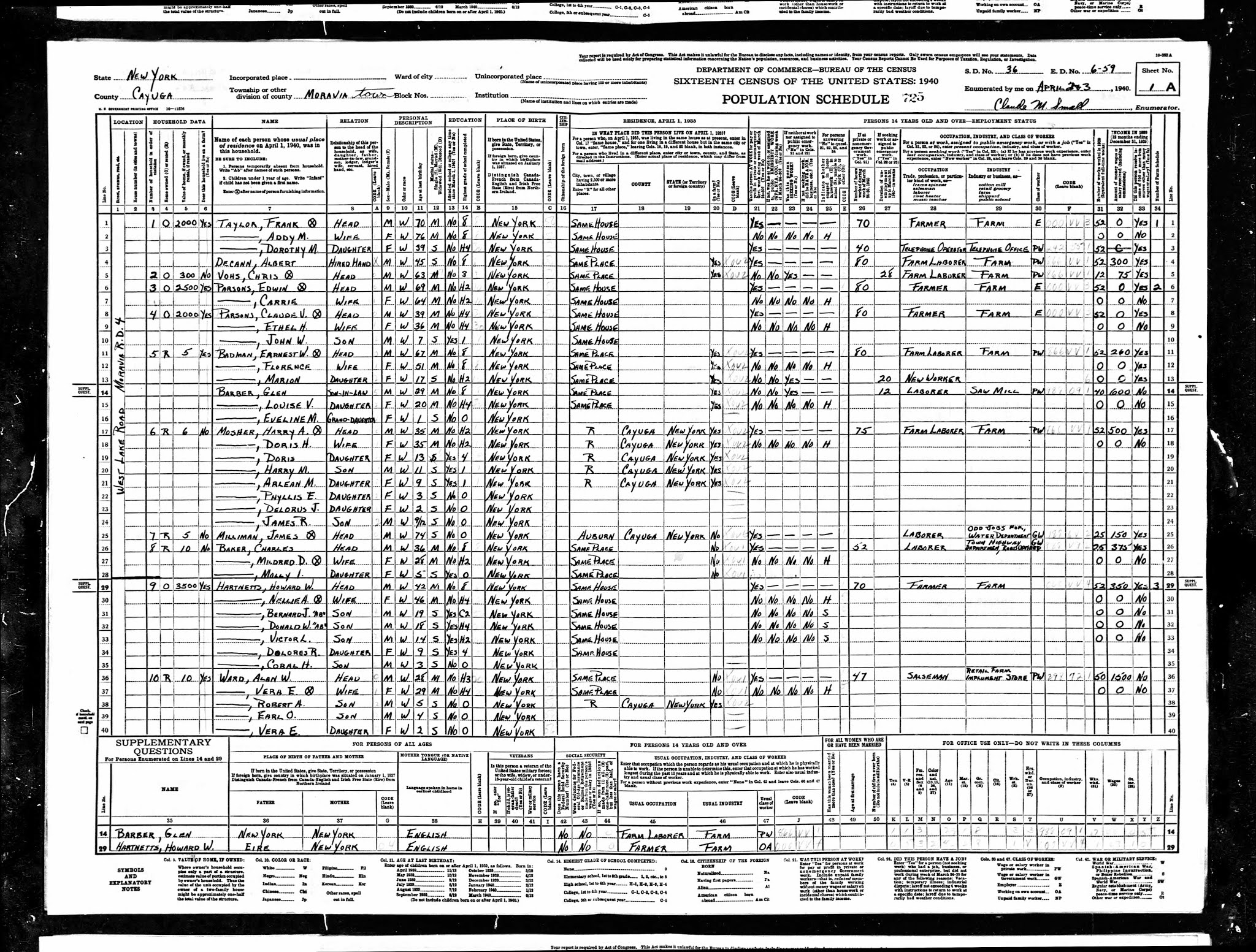
The 1950 Census
So what are you doing to celebrate April Fool’s Day next year? Die hard genealogists know exactly what they’re going to be doing and really are planning out for the holiday already. Why? It’s not to play a joke on anyone, at least we hope not! That is the date exactly 72 years after the 1950 census was taken. So? So! It will be released to the public that day!
Lay in all the snacks. Cancel any appointments already made. Refuse to schedule any new meetings. Okay, so maybe don’t go that crazy- but if you have a lot of people to find and are anxious to find them as soon as possible, maybe you should go to these extremes. Be aware that with so many people looking at the census records at once, many of the genealogy database sites will be slow.
So, what exactly should you be doing to prepare? Start making your lists on paper or some sort of digital such as Word or Excel programs. The more you have done ahead of time, the easier it will be. Remember too, that when the census is first released, nobody has had a chance to go through and index the records yet. It will be weeks or months before you can search them automatically. In the meantime, the only way you can find a person is by scanning through page, by page.
First, who are you looking for? Make a list of all you want to find. List the expected head of household (usually the Dad of the family) followed by the wife and any children. Of course, some households may be grandparents and a child and his or her family. Others may be headed by a widowed or divorced mother. It doesn’t really matter as long as you know who to expect and the name or names of the people you are looking for. When a household is hard to find, I have often searched for a child with a more unusual name thinking that will jump out at me easier than the more common names.
Next, how old were they in 1950? List an approximate age next to each person so that you can use this as reference to gage whether you have the correct person or not. It is easier to have this done ahead of time than trying to calculate many ages on the fly. Of course, not all reported their ages accurately, but this gives you a guideline.
Next where did they live? Hopefully you have at least an idea! The closer you can narrow it down, the better off you will be. A state would be almost impossible to scan through before the indexes are done. Depending on how populated an area is, a county might be doable, but I’d much prefer to look at only a town or village to try to find a family.
In rural areas, you need to have the general area, at least a town level. In states other than New York, this is usually referred to as a township, but I use town as that is what it is commonly called in this area.
In urban areas, it is VERY helpful to have the enumeration district. This limits your search to a certain part of a city instead of the entire population. Steve Morse’s site can help you find them especially if you know from 1940 which enumeration district they were in. His site is at stevemorse.org and has a lot of handy tools for census records, immigration records and a whole lot more. Even if you don’t need to find enumeration districts, it is worth checking out for other tools as well.
So, where can you find these census records once April 1st rolls around? Most of the major sites will have them available as well as NARA (National Archives and Records Administration). The most popular sites would be Ancestry and Family Search.
![]() |
| A page from the 1940 including one of my uncles |
Wednesday, June 17, 2020
Wednesday, May 27, 2020
Friday, March 30, 2018
Family Search's Records Week of March 26th
New Historic Records on FamilySearch: Week of March 26, 2018
SALT LAKE CITY, UT—Hundreds of thousands of new historical records are available this week on FamilySearch from California, Cape Verde, El Salvador, England, Nicaragua,|
Collection
|
Indexed Records
|
Digital Images
|
Comments
|
|
1,526
|
0
|
Added indexed records to an existing collection
|
|
|
3,680
|
0
|
Added indexed records to an existing collection
|
|
|
98,113
|
0
|
Added indexed records to an existing collection
|
|
|
74,216
|
0
|
Added indexed records to an existing collection
|
|
|
138,667
|
0
|
Added indexed records to an existing collection
|
|
|
43,757
|
0
|
Added indexed records to an existing collection
|
|
|
2,308
|
0
|
Added indexed records to an existing collection
|
|
|
42,635
|
0
|
Added indexed records to an existing collection
|
Searchable historical records are made available on FamilySearch.org through the help of thousands of volunteers from around the world. These volunteers transcribe (index) information from digital copies of handwritten records to make them easily searchable online. More volunteers are needed (particularly those who can read foreign languages) to keep pace with the large number of digital images being published online at FamilySearch.org. Learn more about volunteering to help provide free access to the world's historic genealogical records online at FamilySearch.org/indexing.
About FamilySearch.org
FamilySearch is the largest genealogy organization in the world. FamilySearch is a nonprofit, volunteer-driven organization sponsored by The Church of Jesus Christ of Latter-day Saints. Millions of people use FamilySearch records, resources, and services to learn more about their family history. To help in this great pursuit, FamilySearch and its predecessors have been actively gathering, preserving, and sharing genealogical records worldwide for over 100 years. Patrons may access FamilySearch services and resources for free at FamilySearch.org or through more than 5,000 family history centers in 129 countries, including the main Family History Library in Salt Lake City, Utah.
Friday, March 16, 2018
FamilySearch Latest Databases
New Historic Records on FamilySearch: Week of March 12, 2018
SALT LAKE CITY, UT—FamilySearch published new historic records this week from Austria, BillionGraves, B|
Collection
|
Indexed Records
|
Digital Images
|
Comments
|
|
33,987
|
0
|
New indexed records collection
|
|
|
180,735
|
180,735
|
Added indexed records and images to an existing collection
|
|
|
101,059
|
0
|
Added indexed records to an existing collection
|
|
|
2,779
|
0
|
Added indexed records to an existing collection
|
|
|
661
|
0
|
Added indexed records to an existing collection
|
|
|
145,696
|
0
|
New indexed records collection
|
|
|
66,237
|
0
|
New indexed records collection
|
|
|
10,819
|
0
|
Added indexed records to an existing collection
|
|
|
9,386
|
0
|
Added indexed records to an existing collection
|
|
|
687,375
|
0
|
Added indexed records to an existing collection
|
|
|
650,856
|
0
|
Added indexed records to an existing collection
|
|
|
1,804
|
0
|
Added indexed records to an existing collection
|
|
|
15
|
0
|
Added indexed records to an existing collection
|
|
|
22,090
|
0
|
Added indexed records to an existing collection
|
|
|
10,346
|
0
|
New indexed records collection
|
Searchable historic records are made available on FamilySearch.org through the help of thousands of volunteers from around the world. These volunteers transcribe (index) information from digital copies of handwritten records to make them easily searchable online. More volunteers are needed (particularly those who can read foreign languages) to keep pace with the large number of digital images being published online at FamilySearch.org. Learn more about volunteering to help provide free access to the world's historic genealogical records online at FamilySearch.org/indexing.
ABOUT FAMILYSEARCH
FamilySearch is the largest genealogy organization in the world. FamilySearch is a nonprofit, volunteer-driven organization sponsored by The Church of Jesus Christ of Latter-day Saints. Millions of people use FamilySearch records, resources, and services to learn more about their family history. To help in this great pursuit, FamilySearch and its predecessors have been actively gathering, preserving, and sharing genealogical records worldwide for over 100 years. Patrons may access FamilySearch services and resources for free at FamilySearch.org or through more than 5,000 family history centers in 129 countries, including the main Family History Library in Salt Lake City, Utah.
Thursday, February 15, 2018
FamilySearch Announces Its New Records for This Week
New Historic Records on FamilySearch: Week of February 12, 2018
SALT LAKE CITY, UT—Find your ancestors on FamilySearch with new historic records published this week from BillionGraves, Colombia,|
Collection
|
Indexed Records
|
Digital Images
|
Comments
|
|
266,700
|
266,700
|
Added indexed records and images to an existing collection
|
|
|
104,800
|
0
|
Added indexed records to an existing collection
|
|
|
38,635
|
0
|
Added indexed records to an existing collection
|
|
|
70,866
|
0
|
Added indexed records to an existing collection
|
|
|
496,943
|
0
|
Added indexed records to an existing collection
|
|
|
265,029
|
0
|
Added indexed records to an existing collection
|
|
|
1,032,510
|
0
|
Added indexed records to an existing collection
|
|
|
23,310
|
9,394
|
Added indexed records and images to an existing collection
|
Easily find and share this announcement in the FamilySearch Newsroom.
About FamilySearch
FamilySearch is the largest genealogy organization in the world. FamilySearch is a nonprofit, volunteer-driven organization sponsored by The Church of Jesus Christ of Latter-day Saints. Millions of people use FamilySearch records, resources, and services to learn more about their family history. To help in this great pursuit, FamilySearch and its predecessors have been actively gathering, preserving, and sharing genealogical records worldwide for over 100 years. Patrons may access FamilySearch services and resources for free at FamilySearch.org or through more than 5,000 family history centers in 129 countries, including the main Family History Library in Salt Lake City, Utah.
FamilySearch, 50 East North Temple St, Salt Lake City, Utah 84150 United States