Showing posts with label census. Show all posts

Tuesday, July 13, 2021

The 1950 Census

 So what are you doing to celebrate April Fool’s Day next year? Die hard genealogists know exactly what they’re going to be doing and really are planning out for the holiday already. Why? It’s not to play a joke on anyone, at least we hope not! That is the date exactly 72 years after the 1950 census was taken. So? So! It will be released to the public that day!

Lay in all the snacks. Cancel any appointments already made. Refuse to schedule any new meetings. Okay, so maybe don’t go that crazy- but if you have a lot of people to find and are anxious to find them as soon as possible, maybe you should go to these extremes. Be aware that with so many people looking at the census records at once, many of the genealogy database sites will be slow.

So, what exactly should you be doing to prepare? Start making your lists on paper or some sort of digital such as Word or Excel programs. The more you have done ahead of time, the easier it will be. Remember too, that when the census is first released, nobody has had a chance to go through and index the records yet. It will be weeks or months before you can search them automatically. In the meantime, the only way you can find a person is by scanning through page, by page.

First, who are you looking for? Make a list of all you want to find. List the expected head of household (usually the Dad of the family) followed by the wife and any children. Of course, some households may be grandparents and a child and his or her family. Others may be headed by a widowed or divorced mother. It doesn’t really matter as long as you know who to expect and the name or names of the people you are looking for. When a household is hard to find, I have often searched for a child with a more unusual name thinking that will jump out at me easier than the more common names.

Next, how old were they in 1950? List an approximate age next to each person so that you can use this as reference to gage whether you have the correct person or not. It is easier to have this done ahead of time than trying to calculate many ages on the fly. Of course, not all reported their ages accurately, but this gives you a guideline.

Next where did they live? Hopefully you have at least an idea! The closer you can narrow it down, the better off you will be. A state would be almost impossible to scan through before the indexes are done. Depending on how populated an area is, a county might be doable, but I’d much prefer to look at only a town or village to try to find a family.

In rural areas, you need to have the general area, at least a town level. In states other than New York, this is usually referred to as a township, but I use town as that is what it is commonly called in this area.

In urban areas, it is VERY helpful to have the enumeration district. This limits your search to a certain part of a city instead of the entire population. Steve Morse’s site can help you find them especially if you know from 1940 which enumeration district they were in. His site is at stevemorse.org and has a lot of handy tools for census records, immigration records and a whole lot more. Even if you don’t need to find enumeration districts, it is worth checking out for other tools as well.

So, where can you find these census records once April 1st rolls around? Most of the major sites will have them available as well as NARA (National Archives and Records Administration). The most popular sites would be Ancestry and Family Search.
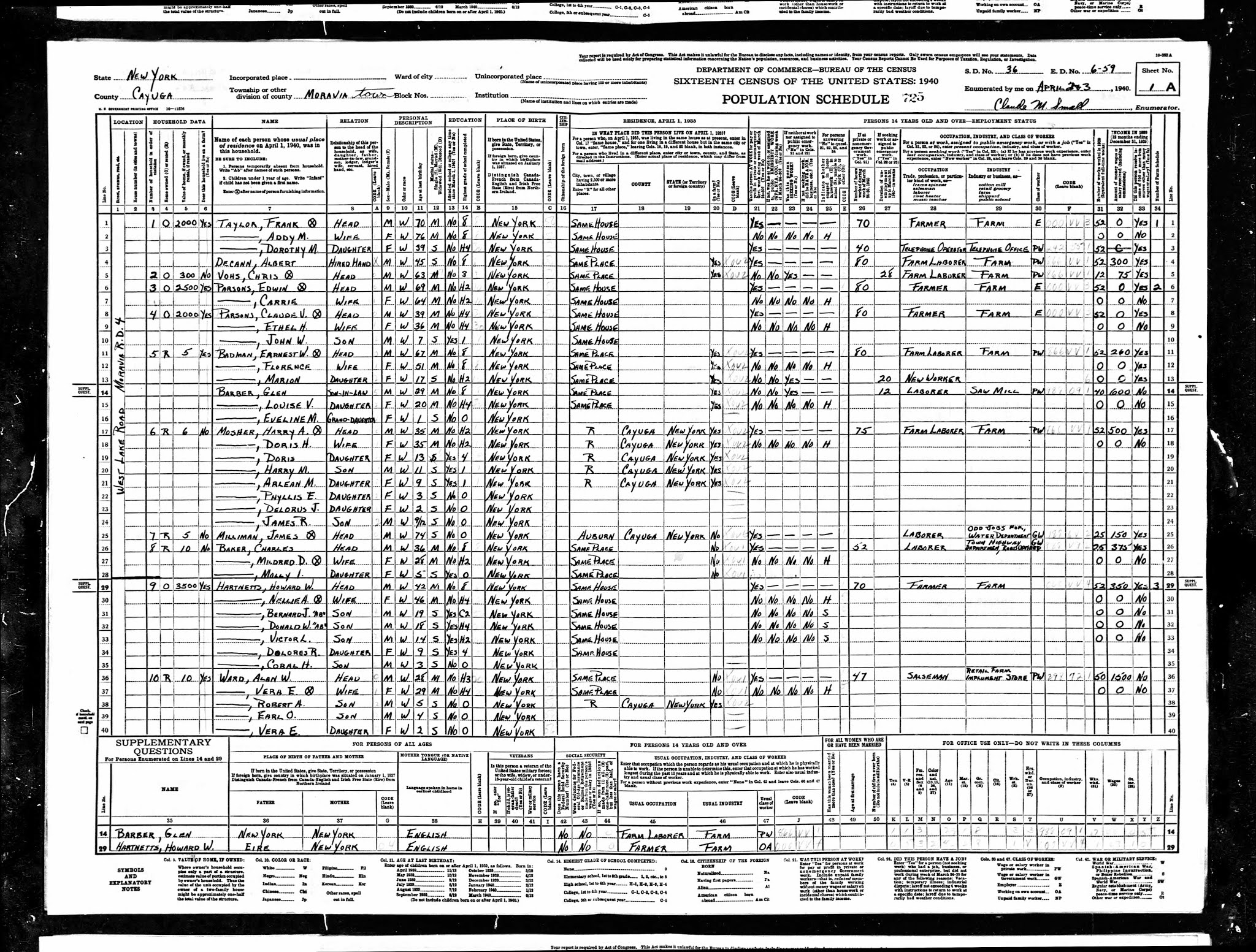

A page from the 1940 including one of my uncles

Sunday, July 10, 2016

Saturday Challenge- Most Census Records


Here is the latst assignment from Randy Seaver and Genea-Musings, if you choose to play along (cue the Mission Impossible music, please!): 

1)  Do you know which of your ancestors appears the most times in the Census records?  How many years?  Are there duplicate entries?  

My great-great-grandmother, Lodema (Tobias) Titus lived longer than possibly any of my ancestors. Her lifetime of 94 years spanned from 1831 to 1926.


Here are the census years she might conceivably have been in:

1835- New York State census.
1840- Federal census
1845- New York State census.

All three of the above census records have similar results. Although I have not found the family yet, they should be in the town of Springport, Cayuga County, New York or fairly close by. Although head of household only, she would have been counted within the household of her father, John Tobias.

1850 Springport, Cayuga Co, NY, p. 219A, dwelling 714, family 720 (Erastus Meyers) Lodema is a servant in the household of Erastus.
1855 Springport, Cayuga Co, NY ED “Corporation” p. [not listed], dwelling 146, family 146, frame house, value $600 (Samuel Titus) Lodemia, age 23, born Cayuga. The head of household is now her husband, Samuel.
1860 Ledyard, Cayuga Co, NY p. 34 dwelling, 242, family 242 (Sherwood PO) [Seabin/ Leabin as first name]- her name was somewhat unusual and often misspelled in records.
1865- Have not found Samuel and Lodema in this state census yet.
1870 Ledyard, Cayuga Co, NY p. 24, dwelling 228, family 227 (Union Springs PO) [Ladeny Tytus]. I’ve rarely seen Titus spelled this way- a definite misspelling and not a variation the family used.
1875 Town of Ledyard is missing from the microfilm roll. She would have been living here during the census, about a year after her husband’s death.
1880 Ledyard, Cayuga Co, NY ED 24, p. 8, dwelling 60, family 61 (Lodema Titus)
1890 Destroyed by fire.
1892 New York State census. Ledyard, Cayuga Co, NY, p. 1, Lodemia Titus, female, age 65, born United States, citizen.
1900 Ledyard, Cayuga Co, NY, ED 31, p. 6B, dwelling, 103, family 105 (Daniel Titus). Daniel is her second child and oldest son.
1905 Ledyard, Cayuga Co, NY, ED 1, p. 21 original, line 20 (Daniel Titus) Lodema, mother, age 72, born US, housework
1910 Ledyard, Cayuga Co, NY, ED 44, p. 5A, dwelling 114, family 117 (Ludima Titus- head)
1915 Ledyard, Cayuga Co, NY ED 1, p. 20 line 21 (Daniel Titus)
1920 Ledyard, Cayuga Co, NY ED 34, p. 5A, dwelling 110, family 112, (Daniel Titus) Lake road
1925 Aurelius, Cayuga Co, NY, ED 2, p. 9, line 10 (Lodema Titus), age 90, born US, housework, Genesee Rd.

So, out of 18 possible census records that she should be in, I have found her in 12 of them. Thanks to her long life-span and the many state census records as well as federal ones during this time period, Lodema would have appeared in the most census records of any of my ancestors.

Tuesday, May 17, 2016

Cheat Sheets


Today I received 3 legal “cheat sheets” in the mail from Amazon. They’re laminated sheets with information printed on them in a convenient 8 ½” by 11” size and hole punched ready to slip into a loose-leaf notebook. Many companies put them out on various subjects. Legacy Family Trees and New England Historical Genealogical Society among other places sell ones on various genealogy topics. Some are called “Quick Sheets”, these I see are entitled “America’s #1 Legal Reference Chart.” Whatever they’re officially called, I refer to them as cheat sheets.

They are much like those pages that you made in high school or college before a test that listed key points on them for you to reference and study. Perhaps an index card that you were allowed to take into a test with you. I still create these from time to time for myself. I have one with models of common citations that I keep handy for doing research. The chart that somebody (The New York State Library?) put out many years ago with the New York State censuses and which counties were included is floating around somewhere as is the one that shows the year each county was formed and from which other counties. All of these various types of cheat sheets are helpful to reference.

The ones I got today are not intended for genealogy, but rather to help law students or paralegals in their studies. One is on terminology, another on research and the third on legal writing. I will be referencing all of these; I’m sure, while taking the Legal Research course at IGHR at Samford University next month. Reading over the research one this afternoon, I was glad to see they have a listing of primary and secondary authority publications. Something that having not worked with them, I often confuse. It is the difference between which are the laws and which are more like interpretations of what the laws mean. The titles are all familiar to me and I smiled to see that some of them are listed by the color of their covers. Having worked in Technical Services in a Law Library for a little over a decade, I immediately recognize those colors along with the titles and can picture exactly where they were on the shelves. After all, not only did I check them in upon arrival, but I often had occasion to shelve or retrieve them as well!

I am sure I will have reason to refer to these cheat sheets often during that week of class. I learned just enough while working in the library to have a beginner’s background in the subject, but will be delving far deeper into the research end now. These are where such forms shine. No matter the subject, if you have a basic grounding in it, but need help on the details either because you haven’t learned them yet or don’t use them often enough, a little help goes a long way. I have found over the years that such cheat sheets are great for quick reference. This is why I either make my own or search them out already created for me by others.

Create a binder of such pieces of information for the location and time period that you are researching. With this, you don’t need to remember all the seemingly trivial facts or where to find that one piece of information. Also, you can remind yourself of sources to look at that might lead to the clue to solve a problem.

I actually have two different types of “notebooks” for these. One set I keep in a binder that can set on my desk or the bookshelf where it is handy. If you’re leaving home, just take out the one or two you need if there is too big a collection. These are very easy to rearrange. The other isn’t a notebook, but rather a digital collection. In a folder on the computer amongst my genealogy is one entitled “Cheat Sheets.” This contains ones that I either haven’t printed out, or that I want to keep a digital version even if it has been printed. If I’m using it often, it is good to be able to print a fresh page when that one begins to get tattered or if it is lost. Also, ones like the citation cheat sheet is handy to have that way as I can copy and paste a sample citation directly into a document or my family tree database and then insert the specific information in place of the generic place holders.

So, even though I fondly refer to these as cheat sheets like we did back in high school, they are actually useful documents for serious research. I use these to quickly reference information that I need to be able to move forward without a lot of diving into books or other records to find that information that I know I read and can’t quite remember.

Monday, April 11, 2016

Transcription vs. Original


Why do you not depend on the index or transcription to a record even if the listing contains all the information? Or rather, why shouldn’t you depend on it?

Often times in a search you will find a transcribed record that is typed rather than the hard to read handwriting of the original document. An index can often have very detailed information within it. In fact sometimes on Ancestry or Family Search databases you can’t see a facsimile of the original document.

Although these records are easier to read and to take information from, we are cautioned not to depend on them. The experts that are writing books or teaching us will warn about mistakes being made. If you have done genealogy for very long yourself, you have probably encountered a few of these differences yourself and know the wisdom of looking towards that original source. However, often we tend to forget or want to opt for the easy way out. I was once again reminded to be careful.

Today I was looking at some records of a family that I became interested in researching over the weekend. Originally I was helping my niece to research some of her ancestors and push back into New England on the line where she had some unsubstantiated information. A paper read at a reunion of the family in the early 1900s hinted at Rhode Island roots for the family, but had no evidence beyond the recollections of a granddaughter who had written the paper.

With my experience in early New York State and Rhode Island families I was able to find some starting points for her and she is now well on her way to establishing that one of the lines mentioned is from Westerly, Rhode Island.

Meanwhile, I started following some of the children to see what might be found there. I came across a couple brothers and at least one sister who became involved with the LDS (Mormon) church early in its history. Palmyra, New York is, as many know, where the Mormon Church began. What I have found interesting is the number of people several counties east of there in the Mohawk Valley that were early followers and move west with them.

Screenshot from Family Search

That is the long version of how I came to be looking at this census record for Alfonso Green in the 1870 census[1].  Looking at the transcription in the clip, you can see that he is mulatto. Or is he? I had no indication of a mixed race in this family. The mother’s line goes back to those in early Rhode Island mentioned above and all seemed to be white. If you look at the actual census, however, you can see that in the race column is a hastily written letter that could be either a “m” or a “w”.  All before and after are listed as white, and unless I find further information, I would read this one as that as well. Sometimes what you think of as a simple fact can be muddled in a transcription!


[1] "United States Census, 1870," database with images, FamilySearch (https://familysearch.org/ark:/61903/1:1:MNCY-KZS : accessed 11 April 2016), Alfonso Green, Utah, United States; citing p. 29, family 209, NARA microfilm publication M593 (Washington D.C.: National Archives and Records Administration, n.d.); FHL microfilm 553,111.