Showing posts with label Albany. Show all posts

Tuesday, August 24, 2021

Ancestors Behaving Badly: Maria Du Trieux Viele Peek


Not Her Tavern, But Typical of the Architecture

 Randy Seaver with his GeneaMusing’s column has posted before about relatives behaving badly. I have another one that has popped up on my family tree.

I can picture my great-grandparents talking about their ancestors. In reality, they probably didn’t know anything about the ones as far back as I’m thinking of. However, it is fun to imagine the following conversation:

Grandpa John: my 7th great-grandmother was quite a character. She ran a tavern in New Amsterdam and after her first husband died, she married who would become my great-grandfather and continued to run it.

Grandma Maria: That’s funny, my 6th great-grandmother was a tavern keeper in New
Amsterdam as well. I wonder how many there were?

Grandpa: Well, mine was quite a character. Not only did she run it herself, but she got charged with serving alcohol not only on the Sabbath but during prayers! Then in 1663, she got banished for selling alcohol to the Indians!

Grandma: Gasp! Mine did too! She went to Fort Orange after that and lived with her son. I wonder if they knew each other….

Hmm, we wonder at the coincidences, don’t we? Would these women have known each other? Grandpa would have said his grandmother was Maria Peek. Grandma would have said her’s was Maria Viele. The truth of the matter was that each would have been often referred to by her maiden name of Du Trieux. The same maiden name? The same first name? Something is happening here.

Yes, it is true, my paternal great-grandparents are actually distantly related through that great-grandmother, Maria Du Trieux Viele Peek. Every once in a while when searching back in the tree, I find some odd relationships popping up in the database. This one came to my attention when I noticed that while Cornelius Viele was my 10th great-grandfather; his wife, Maria Du Triuex was my 9th great-grandmother. They should, of course, be the same number as they would be the same generation. Further investigation found two sons from which descent occurs. Following the lines down, I found where John and Maria (Titus) Ward, my paternal great-grandparents were both descendants of this woman through her two husbands.

Was this woman actually behaving badly? As what seems usual for my relatives, it depends on how you look at it. As with many people’s ancestors, the “bad” depends on the context of the period and its culture. Short of something like murder, or armed robbery, I think we can all see where the “behaving badly” is a subjective decision.

In New Amsterdam during the mid-1600s, church attendance was definitely the norm for people. Ones who did not attend services were looked at askance. These weren’t the services that we experience today. Church services were for most of the daylight hours on Sunday. There was no time for recreation on a Sunday, it was a religious day to be spent in solemn activities: church, Bible reading, prayer. As little work as was necessary to feed man and beast was allowed. However, absolutely no frivolous activities were allowed.

Maria, no matter how religious she might have been, had a business to run. We don’t know if she was deeply religious, or if she agreed with the laws and customs in general. What we do know is that for whatever reason, she made the decision that she had to open her doors on the Sabbath and serve those thirsty men who wanted alcohol instead of being in church.

The fact that she opened up at least occasionally on the Sabbath was bad enough, but at some point she perhaps knowingly, perhaps quite innocently, sold alcohol to at least one person who was an Indian. This was too much for the local lawmakers and she found herself banished from New Amsterdam (present-day New York City). Luckily for her, an adult son lived at Fort Orange (present-day Albany). She fled up the Hudson River to him while her husband, apparently stayed in New Amsterdam. Although some records show that he disappeared in 1663, the same year she was banished.

I have seen references to the existence of legal records on this ancestor of mine and how she behaved badly. However, I haven’t had a chance to look into them yet to get all the real details, but have relied on published records only at this point. Hopefully, I will soon get a chance to investigate where these records are and find more details on her scandalous history.


Monday, August 29, 2016

Places Visited


One of the latest things going around on Facebook has been about putting symbols beside where you have visited or lived. My symbols look a bit different, as I had to find ones on the keyboard as the Facebook ones wouldn’t copy over.
 
I loved these bears at a rest stop in Maine
How do you count if you’ve visited a state? I agree that sitting in an airport shouldn’t count. However, I’ve counted states where I mostly sat in the car. Some states, such as Maryland, and West Virginia, I have done little more than looked out the window as we went down the highway. We might have stopped to eat somewhere along the way, but they were mostly pushing through to get to someplace else. I have counted them as I’ve always tried to make the best of those travels and see what the landscape looked like beyond the interstate and watch to see what attractions might be around. I’ve gathered the brochures at the rest areas (remember when there were all kinds of brochures to gather?) and read through them as we went by.

Catoctin State Park that we passed in Maryland meant looking to see if I could see signs for Camp David or maybe even a presidential helicopter going over! In Kentucky this year, I realized that the hotel we made an overnight in was only a few miles from Fort Knox and we saw the Corvette Museum just off the highway as we went through Bowling Green. Tennessee meant seeing as much of Nashville as we could from I-65 as we drove through-- one trip getting some good views as traffic jams meant we took an hour to inch through there. So, even though some of the states are drive-through ones, I feel as though I did catch a glimpse of some of their features.

Other states I’ve been privileged to stay longer and see more things in. Some, like Alabama, have been for institutes or conferences. Others, such as Florida, I was able to spend about 3 weeks traveling around and exploring with my parents when I was a child. In fact, we did that 3 different times while I was growing up and for a couple weeks again while I was in college. The states in the northeast, of course, have been multiple trips. Virginia and Washington, DC, I got to visit several times as my oldest brother lived in Fairfax county with his family for many years.
In Washington with my niece, Heather
 
Albany, Of course from the state library window!
Put a by the states you have visited. Sitting in an airport doesn't count. The average is 8. How do you match up? Put a where you have lived.

* Alabama

* Alaska
* Arizona
* Arkansas
* California
* Colorado
* Connecticut

* Delaware
* District of Columbia

* Florida

* Georgia

* Hawaii
* Idaho
* Illinois

* Indiana

* Iowa
* Kansas
* Kentucky

* Louisiana
* Maine

* Maryland

* Massachusetts

* Michigan

* Minnesota
* Mississippi
* Missouri

* Montana
* Nebraska
* Nevada
* New Hampshire

* New Jersey

* New Mexico
* New York

* North Carolina

* North Dakota
* Ohio

* Oklahoma
* Oregon
* Pennsylvania

* Rhode Island

* South Carolina

* South Dakota
* Tennessee

* Texas
* Utah

* Vermont

* Virginia

* Washington
* West Virginia

* Wisconsin
* Wyoming
Canada

Mexico

Thursday, July 21, 2016

Family Search & Digital Public Library

I just ran across an announcement of books becoming available on line easier through a joint effort of Family Search and the Digital Public Library. If you don't also subscribe to the NGS email announcement list, Up Front with NGS, you should consider subscribing. You don't need to be a member of the organization to receive their news releases.

I'm not familiar with the Digital Public Library yet, but it looks like a very interesting site with lots of information to explore.

Family Search is a site that I use a lot. It is the website of the Family History Library in Salt Lake City. From their site you can reach the catalog to see what is available and plan a research trip to their library. If you can't travel there any time soon, you can request films be sent, for a fee, to your local Family History Center. If you don't know where that is, of course, you can look it up on the website as well!

For me the real treasure of this site is the items that are available in databases online. All kinds of records including census records, vital records and such can be found for any state and many, many foreign countries. Trees that people have completed and submitted are available and many other things. I could go on for hours about what is available and still miss many key things.

The one thing I've been having fun diving into and discovering lately though, are the various published works that are available through the website. There are many, many titles available and more are being added constantly. A couple months ago, while at the NYS Library, I made copies of some pages from an old genealogy about one branch of my family. In working with these pages and researching this family, I realized that one page was unreadable at the bottom and I was lacking the next page totally. I was thrilled to find the book on the Family Search website and obtain these two pages so that my work wasn't interrupted until I could return to Albany.

I'm not sure how expanded access to this library is going to work or what it actually means for the average users, but I have a feeling we are going to enjoy it even more! In the meantime, I have a new website to explore!


Sunday, June 5, 2016

Greatest Find May 2016- Saturday Challenge


Randy Seaver is away this week, but he sent the following challenge to us in his Genea Musings blog:
For this week's mission (should you decide to accept it), I challenge you to:

1)  I am away at the SCGS Genealogy Jamboree this weekend, having too much fun (I hope!).


2)  What was your best genealogy "research find" in May 2016?  It could be a record, it could be a photograph, etc.  Whatever you judge to be your "best."

Most of my work in May has been collecting information from some published sources and getting them arranged properly in my database along with a little bit of work with documenting gravestones on Find A Grave.

While at the New York State Library in Albany at the first of the month, I did look in one book, which gave me no information on my family. However, one line from that book might have been the greatest find for me. Published by a historical society that has done much research in the area (part of Columbia County, New York), their opinion of the records helps support conclusions I have come to:

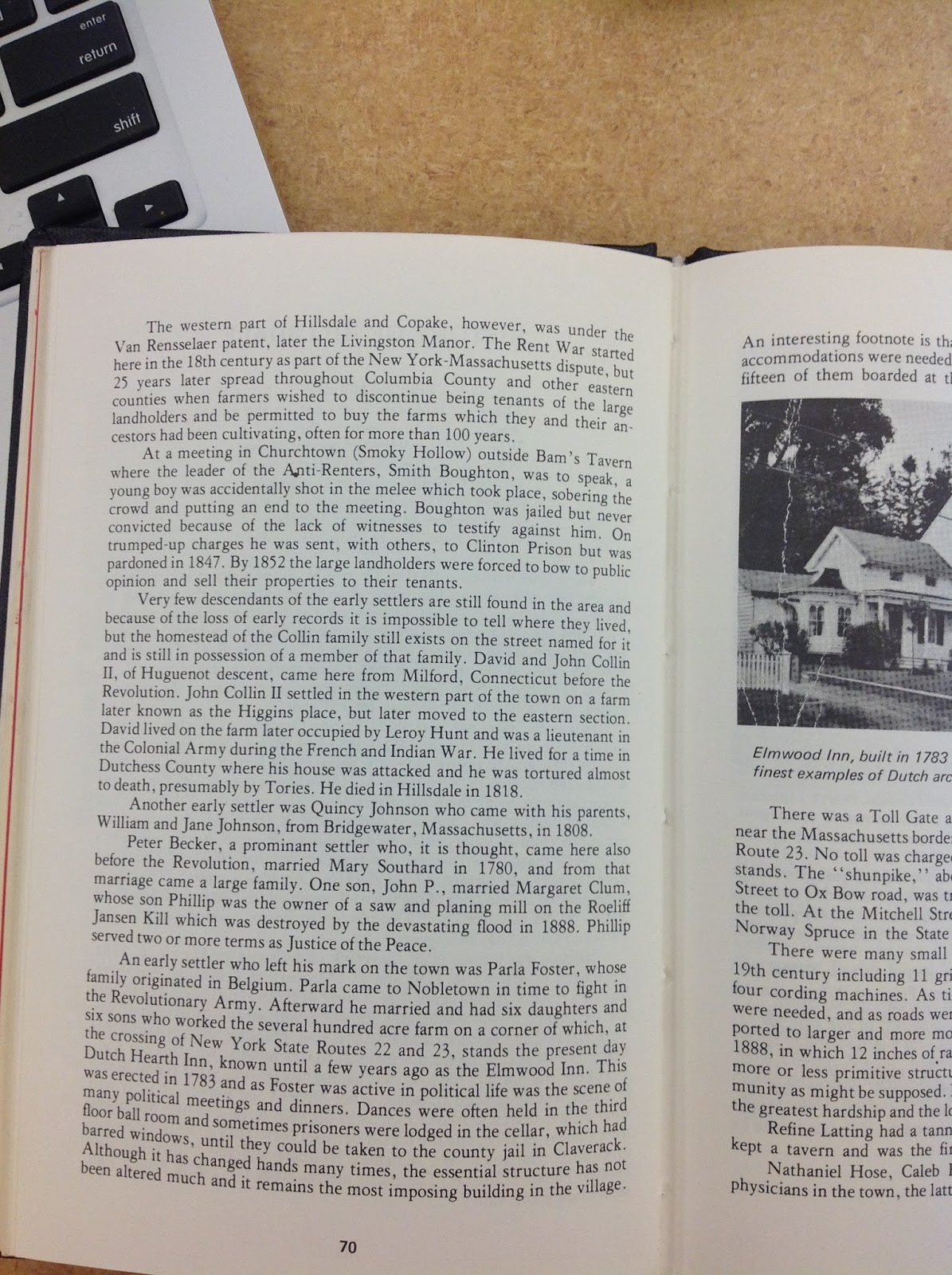
“Very few descendants of the early settlers are still found in the area and because of the loss of early records it is impossible to tell where they lived…” [1]
 
Page 70
One of those apparent early settlers is a man named Ebenezer Wooster and his family. This quote offers up a good explanation of why we can find him in early census records and little else in the area. Other mentions of early settlers on this page state they came from Milford, Connecticut. Ebenezer came from one side or the other of the Housatonic River, having appeared in both the towns of Milford and Stratford.

It is just a few lines on one page of a book and they don’t even mention my family’s name. However, this further supports some theories that I have been developing on the family and helps complete the explanation of lack of records on them. Therefore, it is probably the greatest find of May 2016 for me.


[1] Roeliff Jansen Historical Society, A history of the Roeliff Jansen area : Ancram-Copake-Gallatin-Hillsdale, Columbia County, New York, ([Place of publication not identified] : Roeliff Jansen Historical Society, 1975.), p. 70.


Friday, May 20, 2016

New York State Archives


Name: New York State Archives
Address: 222 Madison Ave, Albany, NY 12230 11th Floor
Phone: (518) 474-8955
Website: http://www.archives.nysed.gov/


Parking: This will take you to a map and information on parking near the library. I have had good luck with the Cathedral parking lot whenever I have visited the library.
Hours:

Monday - Saturday
9:30 a.m. - 5 p.m.

Situated in the state’s capital, the New York State Archives is simply put, the archives for the entire state. It is situated in downtown Albany, a couple blocks from the state capital and at the southern end of the Empire State Plaza Convention Center. The building also contains the New York State Library and the New York State Museum.

Monday through Saturday, the doors to the building open at 9:30 in the morning. Upon entering, you are in a large room with information and guard counters as well as kiosks with information about Albany including bus schedules. At first it can be confusing as archways lead off in all directions. If you have time, feel free to explore through these arches—they are parts the New York State Museum which is free admission. In the northeast corner is the museum gift shop, which among other items, sells many books about the history and culture of the state.

Walking towards the back, you will see a desk for the security guards of the building. On either side of their area are banks of elevators. Turn towards the right and you will see these are marked with the various public floors. The Archives are on the 11th floor.

Does this information sound familiar? It should, the above was taken almost word for word from my previously write-up of the New York State Library and for very good reason. Although two different places, they are in the same building and take up much of the same space.

The archives have many restrictions, but don’t fear. They are also very happy to guide you through what you need. The registration process is very quick and simple; just make sure you have an official picture identification with you- probably your driver’s license. Once you register, you’re good for the year.  There are lockers available to stow any of your stuff that you have along and can’t take in with you. The pictures on this post were taken in the archives with just one stipulation- I was not allowed to take any pictures of people. Luckily, it was just about noon and not many people were working there at the time!

Once you are registered, you will be assigned a table in the archives. Shortly, the items that you requested will be brought out to you. On my most recent trip, I had so many items I was looking for in the library, that I did not plan any time to use the archives. However, in the past I have looked at various manuscripts that people have prepared about families that I am interested in. Some were family trees, and some were letters and such. 

This past December, I had the opportunity to look through a bound atlas of maps of the Wallumschack Patent along the upper Hudson River coming out of the 16 January 1791 deed of partition. These were not the original maps. But rather it is, a late 19th century copy of them. The maps show the lines and divisions of lots in what is now Washington County and across the border in Vermont. Not much information found, except there is that detail of Lot 12. What is that name just north of where Little White Creek runs through? Why, yes it does say “Seth Chase.” Seth, better known in my research as “grandpa times 5,” was a Loyalist at one time, but remained after the Revolution. He ran a tavern somewhere in present day Washington County both before, during and after the Revolution. Did I say somewhere? I think that house symbol in the corner of the property might give a clue. Comparing this map with a present day, we can tell almost exactly where that tavern stood!

Of course, not everyone can find a direct ancestor listed on a map, but you never know what you might find that is either direct or indirect information about your New York ancestors if you explore the archives

Monday, May 9, 2016

New York State Library


New York State Library
Address: 222 Madison Ave, Albany, NY 12230; 7th Floor and 11th Floor
This will take you to a map and information on parking near the library. I have had good luck with the Cathedral parking lot whenever I have visited the library.
Hours:

Monday - Saturday
9:30 a.m. - 5 p.m.


A view from the library

Situated in the state’s capital, the New York State Library is simply put, the library for the entire state. It is situated in downtown Albany, a couple blocks from the state capital and at the southern end of the Empire State Plaza Convention Center. The building also contains the New York State Archives and the New York State Museum.

Monday through Saturday, the doors to the building open at 9:30 in the morning. Upon entering, you are in a large room with information and guard counters as well as kiosks with information about Albany including bus schedules. At first it can be confusing as archways lead off in all directions. If you have time, feel free to explore through these arches—they are parts the New York State Museum which is free admission. In the northeast corner is the museum gift shop, which among other items, sells many books about the history and culture of the state.

Shortly after opening Saturday morning
Walking towards the back, you will see a desk for the security guards of the building. On either side of their area are banks of elevators. Turn towards the right and you will see these are marked with the various public floors. The majority of the library is on the 7th floor. This is where you will find books of general interest, law books and the genealogy area. Genealogy covers almost half the floor. There are many microform readers, copiers and scanners available to you. A set of computers connects to the Internet. All of these must be reserved, but it is very easy to do at the information desk. Another computer gives you access to the card catalog if you haven’t looked at it through the website prior to arriving or need to check for one more item. An old-fashioned paper based card catalog contains surnames with published genealogies related to that name; locality cards and listings from the Daughters of American Revolution (DAR) books contain similar information. Open stacks contain countless genealogies and books regarding counties within New York, books on New Jersey, New England and probably other places as well. A complete set of the NYS DAR books are available as well as boxes of loose papers on various subjects. All of these are fully browsable and accessible.

Some microfilm and microfiche are available in cabinets. Most of these and some items from the catalog must be requested as they are stored on other floors. There are several “pulls” throughout the day, but request early so that you have plenty of time. I’ve requested microfilms to be pulled late in the afternoon for the following day. If you’re coming from out of town, you can also contact them ahead of time and they’ll have them ready and waiting for you upon arrival.
Looking towards the microfilm area

The 11th floor is the archives and items from the library that need special handling. I will write about that floor in a post soon.

Photocopies cost 25 cents each, or you can do digital copies either to a thumb drive (a staff member will scan your drive first to make sure there are no viruses), or you can email them to yourself. Digital copies are free as well as the ability to take pictures with your own digital device as long as no flash is used. Some books are marked “too fragile to photocopy”. There are now special overhead scanners that can be used on these as well as the ability to photograph.

Just a few of the NY counties...
There are so many different items available that it is hard to mention one special item that can be singled out for this library. One thing that comes to mind is that the Capital District Genealogy Society actually staffs the library on some days with volunteers from their society that can help you with your searches! These volunteers are not only experienced genealogists, but they are already familiar with the library and can help you negotiate to where you need to go to find that elusive item. Librarians and staff members are also available and very willing to help, but they are very low staffed and so are busy trying to accomplish many things at once, so often it is better if one of the volunteers is available to help out.

Another thing that is special is the ability to use microfilms of newspapers across the state. While I was there on Saturday, I used some rolls of the Watertown Times to find a couple articles on one of my families. However, if I wasn’t going to be there I could go to my local library anywhere in New York State and request that they Interlibrary Loan them for me from the NYS Library. It is a free service, and I’ve even had a film come to the Syracuse University Law Library (a private institution) a few years ago to look through. Outside of NYS there is a $20 fee for the loan.  

Many years ago, while working on a high school assignment, my father gave me a box of newspaper clippings and photos that his mother had saved over the years. Among those was a yellowed and tattered article from a newspaper telling of her mother’s death. This project started me on my genealogy search. Saturday morning while going through those microfilms, I found the exact issue of the paper that the article about my great-grandmother’s death had come out of and was able to get a digital copy to go along with the tattered one my grandmother had saved.

Friday, April 22, 2016

7 Tips for a Reseach Trip


The lavender will soon be blooming again
The weather is getting better and many of us are thinking of taking trips to further our research. I know I am looking forward to various trips. NYSCOGO, New York State Council of Genealogical Organizations is combining their spring meeting with a trip to the New York State Archives and Library in a couple weeks. I am working on completing my plans for this trip right now. Whether it is to a library, an archive, a historical society or someplace else, here are seven tips that are helpful to make your trip successful.
1-    Check hours of repository
First things first! Check and make sure the repository is open when you’re planning on going. What days are they open and what are the hours? Do they close for certain holidays? Even obscure ones you’re never heard of are possibilities as they are important to the local area. Is there a renovation going on that has them unexpectedly closed? Do you need an appointment to research there?
Check out as much as you can doing a search of their website and any brochures that you might have. This will give you a good idea if your plan to go on a certain day is feasible. Then contact them. Either email or call and double check that they are open that day and at that time. A bonus to this is that many places will be willing to pull information for you about your research interest ahead of time and save you waiting for them to locate that obscure file. One place I visited last summer was small and crowded with files all over the place, as they didn’t have room to organize anything properly. However, when I arrived, the files I was interested in and a few books were neatly stacked on a research table waiting for me!


Albany skyline from across the Hudson River

2-    Check map/directions
Find out where the place is. Seriously. Don’t assume that just because the historical society is in a small town that you can find it easily or that everybody knows where it is. For those of us that don’t use GPS, also don’t assume that everyone can read a map! We once stopped at a AAA office for help as we had left the map we needed in our hotel room. The young girl behind the desk tried to help us, but she couldn’t even figure out how to find the town we were in on the map. Apparently, that skill is not taught in schools anymore like we were taught.
Have an idea of where you are headed. Either use GPS or have the directions and a map handy in the car. Chances are you will miss at least one turn or there will be a detour along the way that you’ll need to account for.
3-    Check about parking in the area
Where can you park once you get there? How much will it cost? Can you use a credit card or is it cash only or perhaps you need to buy a special card to use in those lots. Smaller places won’t have as many issues. Often in small towns you can pull into their driveway or park along the street. However, in larger cities, especially where the state library and archives are located, parking can be at a premium. Check out your options and have a two or three in mind in case your first choice is full.
4-    What can you bring in there or must leave behind.
Are there restrictions on what you can bring into the repository? Are laptops allowed? Is a notebook of research or must you just bring in a few loose sheets of paper? Pens or pencils only? What about cameras or scanners? Is flash photography allowed-- probably not. Can you bring a bottle of water in if it is in a secure container? Archives usually have the most restrictions followed by libraries. Find out what they are and make sure you don’t bring along anything that isn’t allowed or that you can secure it somewhere while you are visiting. Many places with strict restrictions in place have lockers where you can secure your personal possessions while you’re there. It’s always good to find out ahead of time.
5-    Cost for research
Is there a fee to research? Some places charge for the day or by the hour. If you’re a member it might be cheaper or even free to use the facilities. Find out so you aren’t caught by surprise. Some places might be exact cash only, for example. Sometimes if you’re doing a lot of research in one place, it is less expensive to become a member if only for that year.
6-    Copies and other restrictions.
Along with the restrictions I mentioned above, find out what you can copy and how much each copy will cost. Sometimes you can copy items yourself, other times you’ll need to request copies and wait for staff to make them. In the latter case, you might have to wait awhile for the copies, come back another day, or have them sent to you. Find out ahead of time so that you’re not caught unawares! Along those lines, bring a camera along if you’re able to. Even if they make copies, photocopiers break down, and other things happen that might prevent you from getting those copies. Some places will let you take digital pictures of the items instead. I actually prefer this method as I have less paper to carry and there is no need to scan when you get home. 
7-    List what you’re researching!
You already started this didn’t you? Make a list of what you want to look for at this repository. Which people are you researching that lived in the area that they collect information about? Create a research plan before you go. It doesn’t have to be a formal plan like a professional might create. Just list off the things you are looking for. Check their online catalog or listing of resources. Have the call numbers written down and other information ready to go. This will save you a lot of time while you are there.
Along with this, list off your goals of what you want to accomplish. This will help you stay on track and not go off on tangents where you find a lot of interesting information, but forget to look for that very important fact that you were primarily interested in finding out. Set priorities in case you can’t get to everything that you want to. Alternatively, it’s also good to have ideas of things that you might like to look for, but aren’t really necessary in case you get through your list quickly. Be ready to make the most of the opportunity no matter what you find.